Women Aren't Hiding. You're Not Looking.
Women aren't in the shadows because they lack ambition. They're there because we keep dimming the...

Tap into our powerful network of purpose-driven leaders. We deliver a handpicked shortlist of top-tier talent, ready for you to take into your interview process.
Get much more than sourcing. Our dedicated team partners with you end-to-end, using our proven, objective process that blends leadership insight, community perspective, and candidate experience to take the guesswork out of hiring.
We don’t stop at the hire. Our tailored executive onboarding and evaluation, —rooted in discovery insights—aligns your new executive’s strengths with your organization’s needs, pairing coaching, communication strategies, and board partnership planning to set them up for long-term success.
We know how to lead with what’s right—even when it’s not common.
Driven by excellence, grounded in care.
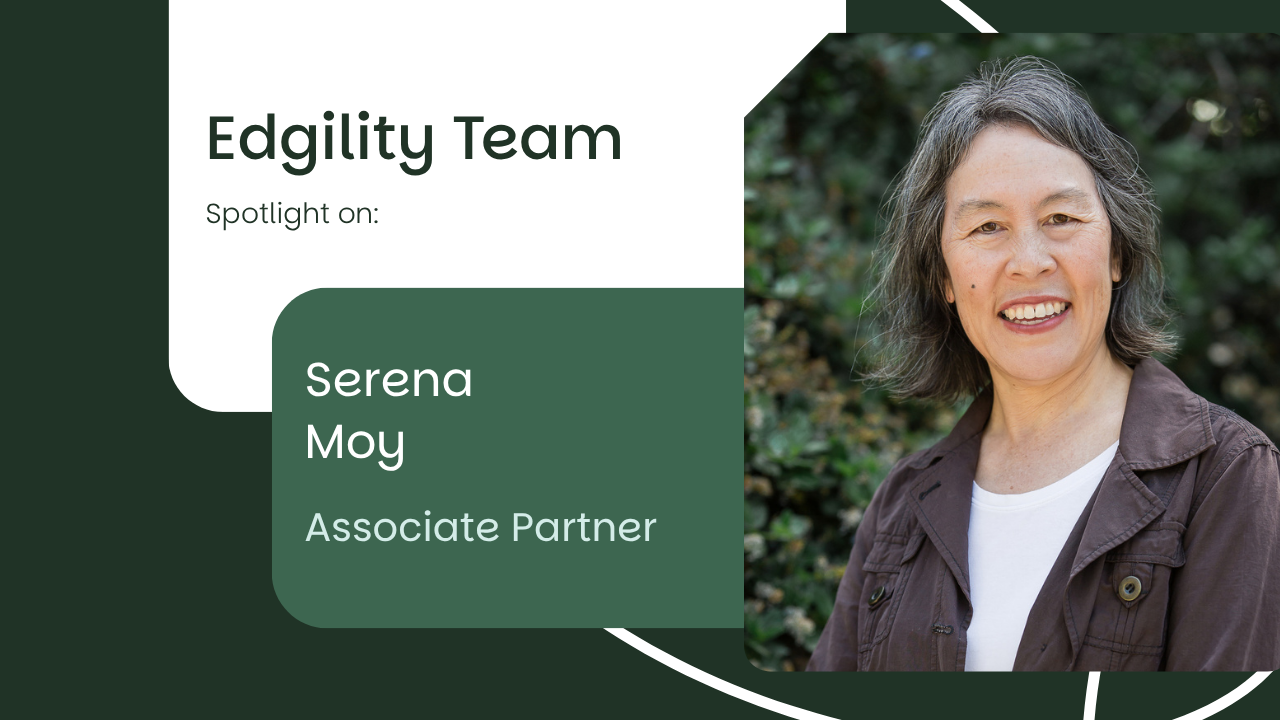
Ten years is a long time to spend in any one place, in any one field. However, looking back on a decade at Edgility, it feels like it happened in a flash. What strikes me most, in this moment of reflection, isn't any single placement or project. It's how much the ground has shifted beneath our feet for the nonprofit and education sectors we serve, and for those of us who do this work of connecting people to purpose-driven organizations.
Ten years ago, working from home, even a couple of days a week, was still something of an anomaly. Most professionals reported to a physical office five days a week, no questions asked. Interviews were conducted over the phone, and nearly every client interview, at every stage, happened in person. There was no alternative to consider.
A decade ago, the infrastructure and the expectations that make hybrid work possible today simply didn't exist for most organizations, especially in the education and social sector nonprofit world.
Then came 2020, and everyone knows what happened next. The pandemic forced organizations to send people home overnight, with little warning and less preparation. At Edgility, we had already built efficient remote-work habits, so the shift wasn't as dramatic for us. But for our clients, mostly education and social sector nonprofits, the change was seismic. Entire organizations pivoted to online platforms and virtual meeting rooms almost overnight.
That period also triggered hiring surges. Organizations that had never needed to staff for a digital-first world suddenly faced huge demand for online support, and we had to move quickly to help them close staffing gaps that hadn't existed a year earlier.
Interviews moved entirely to virtual platforms, and I watched candidates get creative, with some even relocating to work from other countries entirely, something that would have been unthinkable in a fully in-office world.
Coming out of the pandemic, organizations began scaling back and adjusting their in-person requirements. For many, the old five-day model never fully returned. Today, many organizations settle into hybrid arrangements, often requiring just three days a week in the office. People discovered they could be just as productive at home, and they came to value that flexibility deeply.
A March 2025 Gallup poll found that 93% of remote-capable workers prefer either fully remote work or, more commonly, a hybrid arrangement. On the employer side, the nonprofit sector has adjusted accordingly. Robert Half's workplace research found that 39% of nonprofit employers planned to offer hybrid jobs in 2025 to attract and retain skilled candidates, while 36% said they'd support flexible schedules.
At Edgility, we do preliminary interviews virtually, but we still insist on in-person interviews for anyone reaching the final stages of a search. No matter how convenient virtual platforms have become, nothing replaces sitting across the table from someone. Some things about this work simply can't be digitized.
If there's one throughline across these ten years, it's this: everyone has had to become more nimble. Funding for programs has grown tighter, and organizations have had to make harder, faster decisions than ever before. During and after the pandemic, I saw a wave of leadership transitions with long-time founders and CEOs deciding it was finally time for a change.
That wave hasn't slowed down. Nonprofit CEO turnover hit record highs in 2025, even as overall job resignation rates across the broader economy stabilized. The nonprofit and government sector led all industries in CEO exits in 2025, with over 400 transitions recorded that year. Much of this is generational. The sector is facing a "silver tsunami" retirement wave among executives aged 55 and older, but much of it is also about sheer exhaustion. A 2024 survey from the Center for Effective Philanthropy found that 95% of nonprofit leaders cited burnout as a top concern, and boards are only now catching up. Just 34% of nonprofit chief executives currently have a written succession plan in place (get started on your own, here).
I've come to see this constant churn less as instability and more as evidence of an industry that has been asked, again and again, to reinvent itself under pressure with tighter budgets, higher expectations, and less runway for error than our for-profit counterparts often enjoy.
We're in the middle of yet another shift, this time driven by artificial intelligence. There's plenty of debate about whether AI is a net positive or a disruptive threat to this deeply human-centered work. My own view, watching it unfold in real time, is more grounded. I've seen it become a genuinely useful tool for workflow efficiency and administrative support but definitely not a replacement for judgment, relationships, or the nuanced read of a candidate that only comes from sitting with them in a room.
For all this change- in-person to remote to hybrid, phone to Zoom, five-day weeks to three-day weeks, and now the rise of AI there is one thing that has stayed exactly the same, and that is the relationships. The people I've had the privilege of working with over these ten years- my colleagues, candidates, board members, hiring managers, organizational leaders, staff members- have been the real reward of this work.
No platform, no tool, no efficiency gain will ever replace the real, human connectedness at the center of what we do. I don't know exactly what the next ten years will bring to this industry, but if the last decade is any guide, it will demand that we stay nimble, stay curious, and never lose sight of the people at the heart of this work.
Serena Moy is an Associate Partner with Edgility Search, specializing in nonprofit leadership searches and board support. Send her a message to get started on your next search.